Showing posts with label Brazil. Show all posts

Thursday, June 02, 2022

Perversions on Parade: Brazilian Literature of Transgression and Postmodern Anti-Aesthetics in Glauco Mattoso by Steven F. Butterman

Perversions on Parade 
Brazilian Literature of Transgression and Postmodern Anti-Aesthetics in Glauco Mattoso 
by Steven F. Butterman 

This is the first book-length scholarly treatment in English of the Brazilian poet Glauco Mattoso's work, some of which was written during Brazil's most recent dictatorship (1964-85). The author highlights Mattoso's themes of homosexuality, fetishism, and symbolic sadomasochism within a context of a comparative examination of transgressive literature in the Western canon (for example, the French poete maudit, such as Rimbaud, Baudelaire, and Verlaine) with particular emphasis on Luso-Brazilian literature from the Middle Ages to the present. 

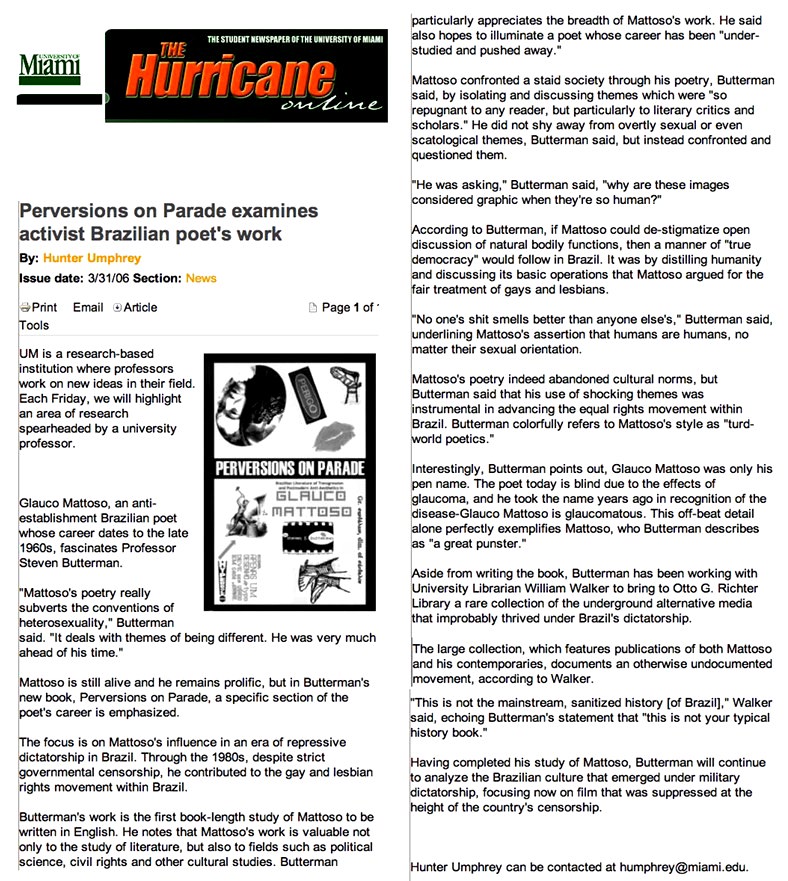
Steven F. Butterman's PERVERSIONS ON PARADE, a respected 2005 issue from Hyperbole Books, an imprint of San Diego State University Press, has recently been featured in the University of Miami newspaper, The Hurricane; click here for the original story. Perversions on Parade is a 2005 Hyperbole Books Volume. Christened in 2004 as an imprint of San Diego State University Press, Hyperbole Books is dedicated to publishing cutting-edge, over-the-top experiments in critical theory, literary criticism and graphic narrative. Imagine some odd, bastard child of SEMIOTEXT[e], Taschen, and Fantagraphics Books raised in the dumpster behind Powells, and you begin to wide the wave of Hyperbole Books. Remember, "Buy the Hype."


Thursday, July 28, 2016

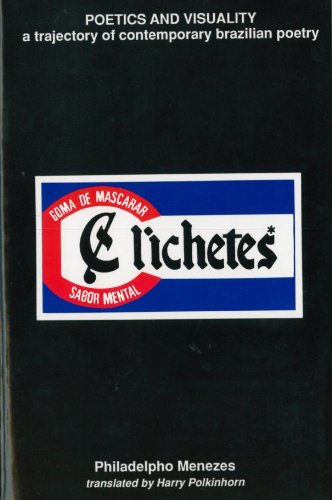
POETICS AND VISUALITY: A Trajectory of Contemporary Brazilian Poetry

An in-depth study by Philadelpho Menezes, professor of Semiotics and Communication at the Pontifical Catholic University of São Paulo, on the evolvement of experimental poetry in Brazil is a worthy read for poetry lovers. Take advantage of the fact that it has been translated into English by Harry Polkinhorn, currently an editor for SDSU Press, and order a copy today! 

POETICS AND VISUALITY: A TRAJECTORY OF CONTEMPORARY BRAZILIAN POETRY is a survey how visuality was incorporated into and formed experimental Brazilian poetry throughout the course of 40 years from an insider's understanding. Part I examines the spatialization of the verse and the concretism that followed in the 1950s. He takes readers through a close look at three versions of concretism: Noigandres, Dias-Pino, and neo-concretism. 

"ruasol" by Ronaldo Azeredo, 1957
Concretism was an attempt to break away from a tradition of verbal expression to begin exploring communication that tapped more into the verbal senses. The differences between the versions of concretism were mostly based on how they perceived space in a poem. In the Noigandres vein, words were arranged geometrically and there was no linear syntax. Dias-Pino concretism prioritized symmetry and mathematics, and neo-concretism was a fusion of the previous two that created an active experience for spectators that was meant to go beyond contemplation and that formed meaning based on the spectator instead of the signs and their positioning according to the poet's taste.


The following sections of POETICS AND VISUALITY look at subsequent movements that expanded the ideas of concretism. Part II is a study of the wordless poetry of the 1960s, and Part III is one on visual poetry. Menezes classifies visual poetry as collage poetry, package poetry, and montage poetry. The creation of such poetry during Brazil's repressive military dictatorship that lasted from 1964 to 1985 was an additional factor that influenced the development of the country's experimental poetry. The social function of art as a critique of the status quo came through in a movement that in itself was inherently a statement against conventional modes of expression. 
"Sick transit" by José Paulo Paes, 1973

Particularly in the last sections of the book, Menezes provides examples of poems that fit into his analysis and he goes into detail about the construction, meaning, and tradition from which each poem stems. POETICS AND VISUALITY, another goodie from SDSU Press, has the perfect combination of direct examples, theory, and chronological organization that can lead readers to appreciate experimental poetry in Brazil and its impact on the international poetry scene. 


Friday, March 30, 2012

Brazilian Graphic Genius! Part of What SDSU Press Studies! Latin American Cultural Studies

A new film ponders human greed and the environment--from Brazil!


Escalade from Birdo Studio on Vimeo.
Production: Birdo | Direction: Luciana Eguti e Paulo Muppet


Check out SDSU Press titles on Brazilian cultural studies here, here, here, and here.

Sunday, February 21, 2010

Two-way street: The Paulista Avenue, flux and counter-flux of modernity | Hey, you! Smartypants! Think you got brains?


Today we have a book for people who have minds and like to use them. Does that sound like you?

Fantastic.

Ever stopped to admire some local architecture? Ever been captivated by the lines of buildings as you walked down the street? Ever gazed at the glass, steel, refracted and reflected light of a chain of high rises and pondered its semiotic value in understanding the flux and counter-flux of modern society within an unpredictable urban fabric?

You will after this book.

Two-Way Street, by Marta Vieira Bogéa, critically examines São Paulo's Paulista Avenue as a coded form communication, a network in which metropolitan space becomes message and discourse.

Followers of architecture, contemporary Brazilian theory or Latin American research in semiotics may already be aware of Bogéa and Dr. Samira Chalub of Pontifical Catholic University in São Paulo, who wrote the forward. If you're not, get hip with this book! You won't regret it.

Below is an excerpt from Dr. Chalub's introduction in Two-Way Street:
She [Bogéa] captures the sense of design of the visible space as an architect while also exposing the invisibility of ambiguous spaces: the sensorial-synthetic, the brilliance, the opacity, the paralyzed, the dynamism of nervous-muscular movement, entropic sounds, the whole spectrum of colors, tonalities, antiquities, modernities... an imaginary de-architectonics of the city's architecture. Poetic flaws in the symbolism of modern design.
A labyrinth of almost indescribable surprises imposes itself upon the rectangular and rectilinear surfaces projected by modern intentions between the use and the passage of "Baudelairean" man in the multitudes.

And that's just the forward!


The list price says $20, but buy it direct from SDSU Press and we'll send it to your for $6.95!

Tuesday, January 26, 2010

Humor & Eroticism in Advertising by Maria Cristina da Silva Martins Back in Print from SDSU Press


San Diego State University Press is happy to announce that one of our more dynamic cultural studies titles is again available.