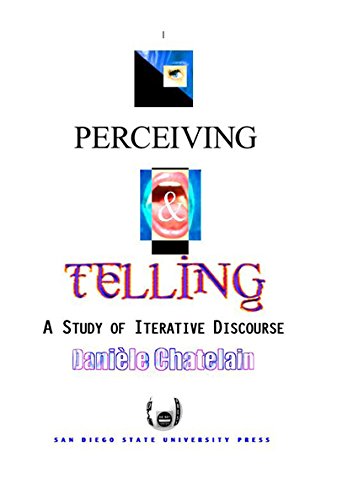
Have you ever pondered
Einsteinian ideas of the spacetime continuum? Or wanted to redefine the parameters
of narrative analysis? Or both? Then you may not be the only one!
Either way, you
may defiantly enjoy destroying the binary structuralization Daniéle Chatelain challenges
in her Perceiving and Telling: A Study of
Iterative Discourse, and iteratively return to each new concept as it
perplexes and unfolds with jigsaw corners connecting past analyst and the
future.
And in case you
were wondering what iterative discourse is, like I was at first, Daniéle
Chatelain plainly explains “Iterative discourse is the synthetic expression of
what has been repeated n times.” Then
she adds “But what is it that repeats?” As each page unfolds so do her intentions
of destruction and rebuilding the boundaries and definitions of iterative
discourse, structure, narrative, analysis, and so on...
This image to the right illustrates a bit of her madness. Below are some complimentary sneak
peeks.
Except for this
image, it has nothing to do with Daniéle Chatelain’s work. But I thought it
could provide a little mental exercise that could help understand the
complexity of her analysis throughout her title.
1)
First start by looking at the larger triangle,
that we may assume is the base of the image, which lies adjacent to our screen.
2)
Now look inside the larger triangle to the
multiple white triangles, made up of smaller triangles. They seem to parallel and
compliment the symmetry of the larger triangle.
3)
Then focus on the negative spaces of darkness. Each
dark triangle points and its even larger counterpart, and in turn point at the
second largest triangle in the picture, which is the center of the overall image.
We begin to
question the complexity of the image by asking, what is the true focus of the
image? “What is it that repeats?” Keep this in mind.
Here
is an example of Daniéle Chatelain actually explaining Iterative literature, by
explaining how English and French find different modes of grammar to portray a
repeating idea, action, or circumstance.
 Here is another example that I fancied from the text, and
believe works much like the triangle mind twister above. It reads:
“The large
candelabra, like bouquets of fire… repeated
themselves, in the mirrors.”
Daniéle
Chatelain sets blaze to her pages when she begins using the text of past analyst
as her fuel. She transforms and grows iterative discourse from the traditionalism
of its past, exclaiming that:
Perceiving and
telling are an eminently human
process, because they are open-ended and thoroughly engaged in transformation.
If the methods of modern science are committed to such a process, it seems as
if many theoretician of narrative still resist this idea of process and
transformation in relation to narrative forms.
The complexity and technicality
of her work are appropriately replicated to enhance the understanding and
analysis. And though she may burn old hierarchies of theory, she opens a new
door of perception, and telling, a new interconnectedness of narrative.
Have you ever
wondered about the interconnectedness of everything? Like our thoughts and
surroundings. That the reality might be, our perception solely lies in the
experiences of our ever revolving day to day environment. And our narrative, our
voice, helps to elaborate this iterative. This is exactly what Daniéle
Chatelain proclaims.

 Repetition. In any narrative structure the function of repetition as a literary device serves more than just a superficial way of attaching meaning to an object or character. Authors employ these devices to expand significance and implore the reader to actively assign connections in the narrative. Daniele Chatelain breaks down this idea of repetition within narrative structures in her book “Perceiving and Telling: A Study of Iterative Discourse” and ultimately outlines a way of recognizing these “four dimensional” (187) environments working within stories. Chatelain explains that utilizing iterative discourse in other areas of interpretation (such as narrative structure, character development, story themes, etc.) can render a seemingly one dimensional text into a multi-faceted piece which questions the idea of space and time.