Showing posts with label cultural studies. Show all posts

Friday, December 16, 2016

Latinx Comic Book Storytelling: An Odyssey by Interview


The “eminent scholar of all things Latino,” Frederick Luis Aldama once again takes us into the world of Latinx comics with his new text Latinx Comic Book Storytelling: An Odyssey by Interview (9). In an intriguing and exciting collection of interviews spanning from Lalo Alcaraz and “La Cucaracha,” to Jamie Hernandez of Love & Rockets fame, to Cristy C. Road and Spit and Passion, Aldama’s compendium of experiences brings into focus the diversity of the Latinx comic tradition, one that runs the gamut from superheroes to political commentary to queer memoirs.

Aldama focuses specifically on the nature by which the authors find themselves participating in the creation of comics and to what effect their cultures influence them. It provides valuable insight into the minds that are currently constructing the Latinx comic tradition, a perspective necessary as the Latinx population is an ever-present one in the comic book market.

That being said, Aldama’s Latinx Comic Book Storytelling: An Odyssey by Interview is an insightful and entertaining experience for readers of all walks. It enlightens them to the writing process and history of many of their favorite comics while simultaneously providing an interesting cultural study in regards to the growing prominence of Latinx contributors to the comic medium.  Aldama’s text directly addresses the question of Latinx representation within the genre. As such, it provides an answer: “The time for waiting is over. Comics by and about Latinos are here to stay. The authors and artists featured in this book are living proof” (269). 

Thursday, July 21, 2016

Line of Fire: Detective Stories from the Mexican Border

The compilation of detective stories from SDSU Press’ Baja California Literature in Translation publication series, Line of Fire: Detective Stories from the Mexican Border, features non-orthodox takes on a genre that has been popular in the Latin American literary tradition. Names like Jorge Luis Borges and Roberto Bolaño have been celebrated as important figures that have paved the way for the detective novel, and as the genre continues to develop, SDSU Press has captured short detective stories taking place in Baja California and its surrounding areas. The stories that form part of Line of Fire were originally published in Spanish in En la línea de fuego: Relatos policiacos de frontera and are written by Gabriel Trujillo Muñoz, Héctor Daniel Gómez Nieves, Leobardo Saravia Quiroz, Edgar Gómez Castellanos, José Manuel Di Bella, Carlos Martín Gutiérrez , Federico Campbell, Harry Polkinhorn, and Sergio Gómez Montero.


The English version of these stories, published by SDSU Press and edited by Leobardo Saravia Quiroz, whose own story is also included in the book, has opened the door of accessibility to a greater audience. Saravia Quiroz comments on the divergence from more conventional forms of the detective story that is clear in Line of Fire, “An indifference towards reason and justice prevails: the entirely modern ‘banality of evil.’ This is one difference from the conventions of the genre.” With the introduction setting the way and the “banality of evil” present in the stories that follow, the reading experience of Line of Fire will have you stepping into worlds of confusion, mystery, and unsolved endings set in the border regions of the US and Mexico. Filled with thoughts and images of paranoia, longing, belonging, betrayal, sounds of music and of bullets, you are bound to become immersed in the Mexican borders portrayed in each story that forms Line of Fire.


Order your copy today! Click here to be directed to our amazon store.


Saturday, July 13, 2013

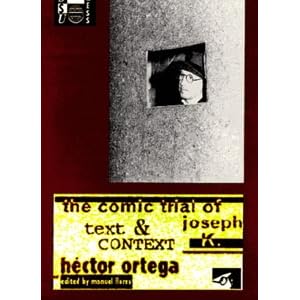
The Comic Trial of Joseph K.:Text and Context... as staged by Hector Ortega

{Direct purchase link from the SDSU Press/Amazon discount store: https://amzn.to/2LutR0u}


It is surprising: I have found that  more people than I realize enjoy the theater- personally I have never been one for it. I am sure that high school Shakespeare has convinced me as well.  But this is not to say that I have not matured or changed my opinion. Maybe I have not seen or read "the right one," so I start here.

After reading The Comic Trial of Joseph K.: Text and Context there are too many places to start. Everything from the introduction by Harry Polkinhorn to the last word of Emily Hicks essay astounds me. The title alone says it all. But despite its forwardness, the book does more for laughs and chair-clenching (un)satisfactions.

For us Lit-Heads, The Context surrounding this adaptation vivifies comedy, when explaining a joke usually ruins it. For example, Hector Ortega invites us in with his "Notes on the Stage Adaptation of Franz Kafka's The Trial" starting with:
Perhaps I've exaggerated in taking a [comic] side (Gogol says that a speech cannot be launched without exaggerating a little), but I'm sure I have exaggerated much less that Jean Louis Barrault and Andre Gide did, or even Orson Welles himself accentuating the tragic and pathetic side of the novel and eliminating any humorous dash that could compromise his gloomy conception and inspire a laugh.
This Book has amazing pictures by Jose Luis Cuevas detailing
what we might read and adding dimension to the work.
Moments like this the author begins a dialogue with us, animating the work that  otherwise demands viewership. Though we could say that Hector Ortega intends to print his stage adaptation; because of a interweaving thread, that of fragmentation, or fractured identity. To further explain, Harry Polkinhorn admits in his introduction:
How can any art escape the straitjacket of identity... Kafka, the Polish Jew living in Prague and writing in German (instead of Yiddish), becomes a symbol for the most extreme of fractured identity politics characterizing our time... Yiddish, German, Spanish, and now English. Each translation betrays the original, again repeating the pure guilt and consequent sacrifice visited upon the individual.
In this comedy you can be
the judge!
If we take this fractured lens of identity further away from the stage, than we see the book as fractured. Because it does not have the stage or actors in front of us, but in our mind. Betraying all the aesthetics of theater, and possibly novels, but transcending a jelly boundary that exist between live actors and that of print.

So, this is where I find the comedy in Hector Ortega's stage adaptation- in these clashes and fractures. An irony that can break bodies of identity, but only from belly laughs. Still, comedy is very dangerous, and Hector Ortega works with meticulous pen to reveal an image and mirror. I can call it Mexicanidad, and I will. But I think we can get a little funky, and get indeterminate. Only for the sake of interpretation. So go ahead, its summer! Enjoy a laugh or two while staying cool with The Comic Trial of Joseph K. Text and Context.

Hector Ortega includes photos documentation that this play happened.
"That's enough for today; so we can say good-bye,  for now, of course."


{Direct purchase link from the SDSU Press/Amazon discount store: https://amzn.to/2LutR0u}

Friday, August 17, 2012

Is It All Over Now? "In Memoriam To Postmodernism: Essays on the Avant-Pop"

Postmodernism is dead. Or so say Avant-Popists. Or so said Avant-Popists close to twenty years ago. So, looking at it today, has Avant-Pop deflated and died as well? Or has it exploded, continuing to combat the fractured yet ironically monolithic technological medium that has us updating Facebook with pictures for our status, while Tweeting about our innermost superficial thoughts, on our way to buy an organic muffin trucked in from out of town, to be washed down with a strong cup of fair-trade coffee from caffeine giant Starbucks, before we head into the nearest stadium-style theater to watch the latest reboot of a multi-million dollar movie franchise based on a TV character made popular in the eighties from a comic book first published in the sixties?

Mark Amerika and Lance Olsen’s In Memoriam to Postmodernism: Essays on the Avant-Pop asked questions in 1995 that we just might be able to answer today. A collection of definitions, essays, and musings, ending with manifestos for the movement, In Memoriam’s organization serves to first explain the measuring tape and then present us with what is to be measured, allowing the reader to move fluidly from the issues of the early nineties to a consideration of what they mean today.

Amerika and Olsen begin the collection with a nod to the neophyte, a slow roll into the twists, turns, and dark alleys of Avant-Pop. Most appealing, and amusing, is the “Avant-Pop Quiz” and “Click Here for More Information” sections, where in the former the editors attempt to frame that which refuses to be hung, while providing a catch-all reading list in the latter.

After the introduction, velocity picks up and celebrated Avant-Pop writers and theorists take over. The table of contents is a media-drunk cavalcade marching in to tear the house down, including such notable names as SDSU’s Larry McCaffery, Harry Polkinhorn, and a wonderfully salacious piece of trans-media “Zipper-Bustin’ ” by Harold Jaffe; the revered (or Avant-Pop Reverend?) Ronald Sukenick; Eurudice; award-winning Japanese scholar Takayuki Tatsumi; and “[a manifesto of sorts]” by “major influence on the avant-set” Raymond Federman.

In Memorium to Postmodernism runs the gamut of topics: Curtis White examines cultural politics, Brooks Landon looks at the hypertextual novel and the future of publishing, Martin Schecter discusses generational divides (an issue swirling around the entire collection and even more poignant in 2012), David Blair dives into film and virtual worlds, and Michael Joyce scrutinizes the tenuous relationship between reading and meaning. A particularly favorite piece from the collection is Steven Shaviro’s “Strategies of Disappearance: or Why I Love Dean Martin.” And damnit, now I love Dino too. So will you. 

Lance Olsen brings the collection to a close, and puts forth a challenge to today’s readers, by forcing us to look at the “Alzheimer’s province in the United States of Amnesia…a pioneer consciousness that doesn’t like to look over its shoulder, check out the rearview mirror, environmentally, militarily, culturally, because objects back there are always larger than they appear.”

In the living age of hypertexts, the death of publishing, “Reality” T.V., YouTube, mash-ups (one of the new words now featured in the updated Merriam-Webster Collegiate Dictionary), instantaneous American Idol voting, CNN’s reporters on the street, and political revolutions sparked by social media, Yeats’ beast is no longer slouching towards Bethlehem to be born. It’s already here and indulging itself at the Hyperconsumer Capitalist party (thanks for the image McCaffery…I’m officially frightened fecal-less).

In 1995, In Memoriam to Postmodernism: Essays on the Avant-Pop asked if we were ready to face the technologically fueled cultural Armageddon coming at us. With relationships between writer and reader, consumer and producer shifting and reversing so quickly we can’t tell who is who anymore, it’s time to look back at these questions so we can start answering them. That is, if we’ve got the stones to do it.


MORE CONTEMPORARY LEAPS INTO AVANT-POP?


This isn't just an essay...
it’s a clinic and a reading list from Jonathan Lethem


Self-proclaimed epiphany addict and techno optimist Jason Silva...
on topics that would get Timothy Leary high

Wednesday, May 09, 2012

The Unveiling of Humor Within Kafka's Tragic Mask: The Comic Trial of Joseph K.: Text and Context by Héctor Ortega and Edited by Manuel Flores (SDSU Press)

Picture this: a script, a series of analyses, a photographic and stylistic smorgasbord of theatrical visions, a graphic and illuminating glimpse into the tortured, jester-like mind of one of the greatest writers of our time: Franz Kafka. This is exactly what one should expect to find within Héctor Ortega's The Comic Trial of Joseph K.: Text and Context, which soars through literary circles as a triumph of adaptation and critical reflection combined in one text. Readers are, at first, presented with   Héctor Ortega's  "mexicanidad" vision of The Trial, which finds its roots in the humanity and soft-spoken comedy of its tragic characters as they transcend the pages of the beloved author's work. Then, following the play's original script, one is treated to several in-depth analyses of the (often neglected) comic visions within Kafka's works by such esteemed artists and critics as Héctor Ortega, Augusto Monterroso, Hugo Hiriart, Manuel Flores, and D. Emily Hicks. And, to top it all off, throughout the text are smatterings of original artwork by José Luis Cuevas as well as photographs of  Héctor Ortega's original stage production. Edited by Manuel Flores, The Comic Trial of Joseph K.: Text and Context is available now through SDSU Press!

Friday, March 30, 2012

Brazilian Graphic Genius! Part of What SDSU Press Studies! Latin American Cultural Studies

A new film ponders human greed and the environment--from Brazil!


Escalade from Birdo Studio on Vimeo.
Production: Birdo | Direction: Luciana Eguti e Paulo Muppet


Check out SDSU Press titles on Brazilian cultural studies here, here, here, and here.

Tuesday, April 06, 2010

From Alyagrov to | Zaum: The transrational poetry of Russian futurism (Paperback) by Gerald Janecek | San Diego State University Press

Hit the image to be instantly transported to our Amazon portal where you can order yourself a copy of Gerald Janecek's definitive study of Dada's cousin, "Zaum."

Zaum (ZA-oom) is more than just a fun word to say. It's a Russian Futurist neologism describing a hard-to-pin-down art movement with an equally hard-to-pin-down translation: "trans-mental," "transrational," "trans-sense," "metalogical" and our favorite, "beyonsense."

The root "um" translates to mind, wit, and intellect. "Za" means "beyond the bounds," "trans" and "on the other side." The two combined describe an innovative school of poetry meant, as author Gerald Janeck puts it, to go "beyond the limits of a locale... like rational, intelligible discourse."

Zaum influenced later groups and movements, such as Pop Art, Nouveau réalisme, and Fluxus.

Finding your interest piqued and your curiosity bubbling? Then check out our book, Zaum: The Transrational Poetry of Russian Futurism, one of the defining works on the movement!