Showing posts with label theory. Show all posts

Monday, November 03, 2014

The Avant Garde in Attitude: Fluxus The History of an Attitude by Owen Smith—Aesthetic Critical Theory from San Diego State University Press (SDSU Press)

What breaks against the mold of convention, society and traditional cookie cutter art, literature, film, and media? Fluxus the History of an Attitude. The book that shows how new avant grande movement has begun to develop and expand. The evolution making way to allow for new abilities of thought and expression while continually moving away from conventional thought, mainstream ideology, and break from the bonds of conformity that has long limited true freedom of expression.

Medias such as paint, clay, ink and canvas are stripped away by fluxus. Instead, deciding to use what is left over by the community, the trash and carbon footprints transform into art. This helps build an individuality without relying on companies to create mediums and tools for production of expression, taking away the chains that suggest their route of creativity.

Fluxus is a form which the group has described as “non-art” since they do not wish to be associated with the same constraints as traditional artists who follow rules, ready to please the masses and unable to think outside the box.

It takes an open mind to be able to find art in all things, especially ones that are new and test your ability to look for beauty in things you originally had never noticed due to their “traditional” uses. Such examples include furniture, office supplies, electronics, and other things that help your day run smoothly, things that are easily bought and discarded.

“Fluxus [is] serious about not being serious” (242)

Being serious is by society standards, not the fluxus standard. One can be serious about their art but not be serious about what society wants them to do with art or create with their talent.

Fluxus in 2014 has evolved, as intended. Art being one of the largest mediums for thought and the new fluxis kit's which are sold by artists, each kit is different and can be manipulated. Read Thing/Thought Fluxus Edition to see examples of the "kit".

One art show in 2014 at the Rush Auditorium at Florida Southwestern State College gave a fluxus show with improve opera, spoken word poetry, and for the finale a whipped creamed blow up alligator topped with cherries and nuts which the audience was allowed to partake a piece of the art with a chip. Read the full article here.

Fluxus has continued to invade society with its unique form of individual art, ideas and media. To take a closer look at fluxus check out the full critique and essays by following this link.


Saturday, July 13, 2013

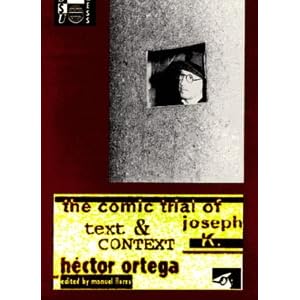
The Comic Trial of Joseph K.:Text and Context... as staged by Hector Ortega

{Direct purchase link from the SDSU Press/Amazon discount store: https://amzn.to/2LutR0u}


It is surprising: I have found that  more people than I realize enjoy the theater- personally I have never been one for it. I am sure that high school Shakespeare has convinced me as well.  But this is not to say that I have not matured or changed my opinion. Maybe I have not seen or read "the right one," so I start here.

After reading The Comic Trial of Joseph K.: Text and Context there are too many places to start. Everything from the introduction by Harry Polkinhorn to the last word of Emily Hicks essay astounds me. The title alone says it all. But despite its forwardness, the book does more for laughs and chair-clenching (un)satisfactions.

For us Lit-Heads, The Context surrounding this adaptation vivifies comedy, when explaining a joke usually ruins it. For example, Hector Ortega invites us in with his "Notes on the Stage Adaptation of Franz Kafka's The Trial" starting with:
Perhaps I've exaggerated in taking a [comic] side (Gogol says that a speech cannot be launched without exaggerating a little), but I'm sure I have exaggerated much less that Jean Louis Barrault and Andre Gide did, or even Orson Welles himself accentuating the tragic and pathetic side of the novel and eliminating any humorous dash that could compromise his gloomy conception and inspire a laugh.
This Book has amazing pictures by Jose Luis Cuevas detailing
what we might read and adding dimension to the work.
Moments like this the author begins a dialogue with us, animating the work that  otherwise demands viewership. Though we could say that Hector Ortega intends to print his stage adaptation; because of a interweaving thread, that of fragmentation, or fractured identity. To further explain, Harry Polkinhorn admits in his introduction:
How can any art escape the straitjacket of identity... Kafka, the Polish Jew living in Prague and writing in German (instead of Yiddish), becomes a symbol for the most extreme of fractured identity politics characterizing our time... Yiddish, German, Spanish, and now English. Each translation betrays the original, again repeating the pure guilt and consequent sacrifice visited upon the individual.
In this comedy you can be
the judge!
If we take this fractured lens of identity further away from the stage, than we see the book as fractured. Because it does not have the stage or actors in front of us, but in our mind. Betraying all the aesthetics of theater, and possibly novels, but transcending a jelly boundary that exist between live actors and that of print.

So, this is where I find the comedy in Hector Ortega's stage adaptation- in these clashes and fractures. An irony that can break bodies of identity, but only from belly laughs. Still, comedy is very dangerous, and Hector Ortega works with meticulous pen to reveal an image and mirror. I can call it Mexicanidad, and I will. But I think we can get a little funky, and get indeterminate. Only for the sake of interpretation. So go ahead, its summer! Enjoy a laugh or two while staying cool with The Comic Trial of Joseph K. Text and Context.

Hector Ortega includes photos documentation that this play happened.
"That's enough for today; so we can say good-bye,  for now, of course."


{Direct purchase link from the SDSU Press/Amazon discount store: https://amzn.to/2LutR0u}

Thursday, September 06, 2012

An Experimental Journey in Avant Garde Wizardry and Synthesis! All within Renato Barilli's Voyage to the End of the World (SDSU PRESS)


Renato Barilli accomplishes something wildly different and radically unexpected in his Italian translated work, Voyage to the End of the World. By combining extravagantly experimental poetry as well as deep rooted critical discussion, Barilli brilliantly blazes a spotlight on the Italian experimental poetry of the 1960's-70's in a theoretical context indebted to Saussure's concept of the linguistic sign and Freud's notion of pre-oedipal bliss. 

Voyage to the End of the World encapsulates the spirit of the poet through its discussion and inclusion of various forms of puns, visuality, neologisms, and the full range of devices that poets have relied on to expand the capabilities of expressive language for years! 

Experience a wicked rekindling of avant garde in Voyage to the End of the World, available through the SDSU Press!


And check out the explosive performance of Totino, an author of one of the works in Barilli's journey, below!


Wednesday, May 09, 2012

The Unveiling of Humor Within Kafka's Tragic Mask: The Comic Trial of Joseph K.: Text and Context by Héctor Ortega and Edited by Manuel Flores (SDSU Press)

Picture this: a script, a series of analyses, a photographic and stylistic smorgasbord of theatrical visions, a graphic and illuminating glimpse into the tortured, jester-like mind of one of the greatest writers of our time: Franz Kafka. This is exactly what one should expect to find within Héctor Ortega's The Comic Trial of Joseph K.: Text and Context, which soars through literary circles as a triumph of adaptation and critical reflection combined in one text. Readers are, at first, presented with   Héctor Ortega's  "mexicanidad" vision of The Trial, which finds its roots in the humanity and soft-spoken comedy of its tragic characters as they transcend the pages of the beloved author's work. Then, following the play's original script, one is treated to several in-depth analyses of the (often neglected) comic visions within Kafka's works by such esteemed artists and critics as Héctor Ortega, Augusto Monterroso, Hugo Hiriart, Manuel Flores, and D. Emily Hicks. And, to top it all off, throughout the text are smatterings of original artwork by José Luis Cuevas as well as photographs of  Héctor Ortega's original stage production. Edited by Manuel Flores, The Comic Trial of Joseph K.: Text and Context is available now through SDSU Press!