
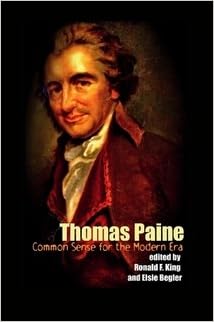
 In 2005 a conference titled Thomas Paine: Common Sense for the Modern Era was held at San Diego State University in what was part of an effort to begin a series of tributes to great thinkers of the early stages of America. Among these intellectuals that worked against the current and defended the ideals that theoretically define the United States as a nation today is the often underrepresented Englishman who moved to America in 1774 and quickly began advocating for independence. In 2007, a volume was published by SDSU Press that went by the same name as the conference and captured the presentations and panels that discussed Thomas Paine’s ideas, life, and legacy.
In contrast to other venerated figures of the American Revolution like John Adams, James Madison, and Alexander Hamilton, Thomas Paine believed in an American independence that would function atop newly established pillars of society. He did not simply want America to move away from British rule, but instead wanted to diverge from a British mentality of what civilization was supposed to be. Paine’s experience with British style rule both in England and in America was one in which he had extensive exposure to the deprivation of the masses through state brutality that led to poverty and heavy handed punishment that served to keep the elite in their privileged state. In his hometown of Thetford, Paine grew up watching civilians being executed in the gallows for petty crimes spurred by need rather than malice such as stealing bread. In America, inadequate representation of the majority’s interests and elitism were also present, but there was room for renewal through independence.
In 1776 Paine’s pamphlet, Common Sense, resonated strongly with the sentiments of many who lived in the British colonies.
"Common sense is the understanding that it is the people who have to have sovereignty. Thus, Paine wanted to rid America not just of British soldiers, but of the entire British system. It was a system of imperialism, of colonialism, of tyranny and slavery. He wanted to start anew, with a new system based on justice and rights, equality and reason. Give power to the people, and establish a government that ensures the adequacy of people to be what they can be. Do not merely give people rights; give them the idea of using those rights” (McCartin,71)."


