Wednesday, May 06, 2020

Iterative Discourse is the Key to a Great Narrative: Danièle Chatelain's Perceiving and Telling: A Study of Iterative Discourse #sdsupress


by David Ornelas
#repost/adaptation: Yarely Alejandre May 2012

Order now!
Ever wonder what the trick is to writing a captivating narrative? The answer is repetition. 

In her book, Perceiving and Telling: A Study of Iterative Discourse, Danièle Chatelain explores the dynamic of space and time within the art of iterative discourse. In terms of story versus narrative, the separation of space and time is, in a sense, built into the very terms in which that distinction is traditionally formulated. In Gerald Prince's, A Dictionary of Narratology, "story" is the content of the narrative; it is a succession of events "with an emphasis on chronology" (91). In her study, Chatelain seeks to show how these dimensions exist on a "spacetime continuum." The book is provided with a glossary of terms.

Chatelain develops the concept of repetition helping it grow from a boring and flat concept to one that houses the fluidity of perception. Chatelain says, "Perceiving, therefore, should be considered as a central element in the functioning of any narrative" (94). The tricky concepts that go into an excellent narrative are thoroughly dissected as she also studies the division between heterodiegetic and homodiegetic narratives. Writing a narrative can sometimes feel like an overwhelming task, but with Chatelain's insight on the matter (and of course with her glossary on hand) the job will be less daunting and instead become an exciting challenge.

More pages from Chatelain's monograph:


Monday, May 04, 2020

San Diego State Univerisity Press brings you, Gabriel Trujillo Muñoz -- Permanent Works: Poems!

Permanent Works: Poems 1981 - 1992
Baja California literature in Translation
by David Ornelas 
#SDSUTwitter
#SDSUFacebook 

About the Author
Gabriel Trujillo Munoz
Gabriel Trujillo Muñoz was born in Mexicali, Baja California, Mexico, in 1958. He is a poet, fiction writer, cultural journalist, essayist, editor of anthologies. Permanent Work gathers representative poems from the last decade of his production. His record of publications is the most extensive among current writers of Baja California. He works for the Autonomous University of Baja California in Mexicali, where he resides. Permanent Work: Poems 1981-1992 (Baja California literature in translation) is a wide-ranging and inclusive collection of his moving poetry.

The insight into Permanent Works
Permanent Work: Poems 1981-1992 by Gabriel Trujillo Munoz covers a variety of poetic genres with visual images that will illuminate and intrigue the mind. Humberto Felix Berumen claims that Munoz writes with "measured tone of analytical reflection and the sobriety of a language whose fundamental intent is to seek answers to the questions that he puts forth."  Dare to immerse yourself into the poetry and questions of life a death posed by Munoz? 

The Love for Poetry
The collection consists of almost all poems in verse, excluding about six or so poems written in prose, demonstrating Muñoz’s range in writing skills. The back-cover of the collection states he was a “key player in the Baja California’s literary Renaissance of the 1980s”, creating context for me as I had never heard of Muñoz’s work before reading this collection. The diverse spread of poetry provides a portfolio to those who have no or little experience with this poet’s works.


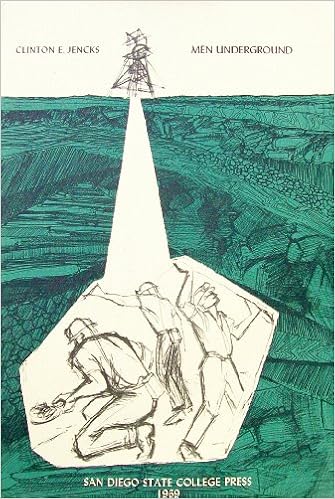
Written by Clinton E. Jencks, Men Underground: Working Conditions of British Coal Miners Since Nationalization examines the British coal mines in 1947. Jencks's first-hand account brings out the issue of public vs private ownership. Jencks was a social activist famous for union organizing among New Mexico's miners. This is an outstanding book for anyone fascinated by the history of labor rights.


Sunday, May 03, 2020

SDSU Press Brings You Three Publications Documenting of the Kumeyaay and Other Native American Nations!!


In 2014 the documentary First People-Kumeyaay was produced by Industrial Strength Television, Inc. Drawn from over 70 hours of oral interviews with culture bearers from the Kumeyaay Nation and focused on the importances of sharing and maintaining cultural heritage and passing it on to future generations, the documentary quickly won numerous awards, including the 2014 Borrego Springs Film Festival "People's Choice" award for best documentary, and has been nominated in 2015 for a National Academy of Television Arts and Sciences Pacific Southwest region Emmy award in the documentary category.


"To the beginning of time" takes on a different meaning when referring to San Diego county and Northern Baja, California. In this case, it comes from the first true San Diegans, otherwise known as the Kumeyaay (also known as the Tipai-Ipai, Kamia, or Diegueño).  KPBS' Emmy-nominated film First People - Kumeyaay  explores Kumeyaay culture with probing insight into their nation(s), located throughout the county of San Diego and in the north of Baja, California. There has been substantial interest in this native community, whose legacy and cultural identity cannot be neglected when thinking about the people and history that constitute modern San Diego/Baja culture.  Here is a teaser from the new documentary:


SDSU Press has been committed to documenting the myriad complexities of the Kumeyaay and other Native American nations for decades.  Three publications, still in print, and now on sale via our Amazon.com virtual bookstore are particularly salient:


A Teacher's Guide to Historical and Contemporary Kumeyaay Culture (A Supplemental Resource for Third and Fourth Grade Teachers) written by Geralyn Hoffman and Lynn Gamble, invites the reader to become one with the Kumeyaay Nation and delve into their modern culture. Gamble's interest and publications on a wide variety of topics from the Chumash Indians to the origin of the plank canoe allows for an insightful and in depth approach to the Kumeyaay culture.

Additionally, William D. Hohenthal, Jr. takes the reader back into history in Tipai Ethnographic Notes: A Baja California Indian Community at Mid-Century. This dynamic and enlightening book recreates the past through their ancient traditions, ethnographic info, and Tipai accounts of material culture, complete with a map that reveals elusive and dormant trails for the reader to explore.

Mii Anmak Nyamak Kweyiwpo: Jwanya Kumiai Kuwak / Footsteps From the Past into the Future Kumeyaay Stories of Baja California:
This wonderful trilingual collection of Kumeyaay Texts /Kumiai Textos is a delight for all concerned with Indigenous oral literature. In a rapidly transforming world, it is especially important to document and preserve these fascinating stories about Coyote, Frog, Wildcat and others, so that they can continue to serve as resources for community identity and nation-building for these groups, and as subjects of scholarly research

Friday, May 01, 2020

A Teacher's Guide to Historical and Contemporary Kumeyaay Culture #sdsupress #SDSU

Order Now via our Amazon shop:
https://amzn.to/2VXujeR

A Teacher's Guide to Historical and Contemporary Kumeyaay Culture
(A Supplemental Resource for Third and Fourth Grade Teachers)  

From the Introduction: "The first version of this project was produced as part of a master’s thesis at San Diego State University. Geralyn Hoffman completed her B.A. in Anthropology and Archaeology at Boston University and her M.A. in Anthropology at San Diego State University--later on becoming the Education Coordinator at the San Diego Museum of Man. Lynn Gamble is Associate Professor and Director of the Collections Management Program in the Department of Anthropology at San Diego State University. Her recent publications have focused on a wide range of topics, including the origin of the plank canoe in the New World, the emergence of a ranked society among the Chumash Indians, trading activities in Southern California, adaptations to paleoclimatic change, and the challenges surrounding site preservation in the United States. Her recent research entails working with the Kumeyaay on both sides of the border in the interpretation of cultural landscapes and material culture. 


This guide was published with the generous support of the Campo Kumeyaay Nation, the Barona Band of Mission Indians, the Sycuan Band of the Kumeyaay Nation, the Southwest Consortium for Environmental Research and Policy, and the Institute for Regional Studies of the Californias."


Wednesday, April 29, 2020

ZAUM! #SDSUPress

Zaum!

The Transrational Poetry of Russian Futurism


Description
If Dada and the European Avant-garde are your thing, then brace yourself for Gerald Janecek's ZAUM. According to Charlotte Douglas (Russian and Slavic Studies, NYU), Janecek’s Zaum "is an encyclopedic account of zaum or 'beyonsense,' the most distinctive feature of Russian avant-garde art and poetry early in the 20th century. Janecek has mined a myriad of arcane and inaccessible sources, gathered the entire historical record in one place, and made it readable and comprehensible. His account of zaum theory and practice will be indispensable for anyone interested in modern poetry and art. Certainly it will become a standard text for all students of Russian Futurism."


Author Bio
GERALD JANECEK is a professor emeritus of Russian at the University of Kentucky. He is the author of The Look of Russian Literature: Avant-Garde Visual Experiments, 19001930ZAUM: The Transrational Poetry of Russian Futurism; and Sight and Sound Entwined: Studies of the New Russian Poetry; and the editor of Staging the Image: Dmitry Prigov as Artist and Writer.

Book Review
"Should such poetic brinkmanship be granted a place in poetry? Yes, argues Janecek, because it is a value working against the automatization of language and thus of life. More than eighty years after its inception, it is indeed remarkable that Zaum is still controversial, still avant-garde, still denigrated as having gone too far. In sum, Janecek's work is an extraordinarily comprehensive piece of scholarship, which succeeds in compressing several books' worth of research into one. He has raised the study of Zaum to a new level and in doing so has dampened none of its vitality." 

- Crispin Brooks, University of London


Monday, April 20, 2020

Follow SDSU Press on Twitter!

SDSU Press's Comix Imprint Has a New Title Debuting in May 2020! THE PHANTOM ZONE AND OTHER STORIES by José Alaniz

More Than Money: A Memoir by Claudia Dominguez -- From San Diego State University Press #sdsupress

 More Than Money: A Memoir by Claudia Dominguez


MORE THAN MONEY: A Memoir by Claudia Dominguez is a graphic novel/memoir that recounts the true story of how the author's family recovered their father after he was kidnapped in Mexico City. The reader will feel the helplessness of the kidnapping but also be heartened by the humor and warmth of people who find themselves in a crisis.

MORE THAN MONEY is the first issue from Amatl Comix, a new SDSU Press imprint. Amatl Comix publishes all the dynamic, contemporary graphic narratives we can get our hands on! Our first issue showcases the brilliant work of an up and coming Mexican comic book star, Claudia Dominguez.


Sunday, April 19, 2020

Latin American / Brazilian Urban Studies & Late 20th Century Urban Studies from San Diego State University Press


Modernism, Brazil-style! A Latin American cultural critique classic from SDSU Press--now on sale at our Amazon outlet mall: https://amzn.to/2KJuPXf 

With TWO-WAY STREET: THE PAULISTA AVENUE, FLUX AND COUNTER-FLUX OF MODERNITY, Marta Bogéa presents São Paulo's Paulista Avenue from "the other side of the street." Bogéa offers a semiotic analysis of the richly varied architectural styles of this major Latin American urban space. In this work urban studies and cultural studies fuse--urban space is seen as a coded form of communications network that emerges via careful critical examination. 

Think Barthes meets Brazil, and you begin to parse Bogéas achievement in this study. 

By considering apparent contradictions between the official hegemonic discourse of unified styles, and and what abuts and abrades them from the surrounding, unpredictable urban fabric, the author demonstrates the interventionist and utopian role of criticism. Separate chapters cover the period from the great mansions through modernism and the International Style as it appeared (and evolved) in São Paulo. For scholars and graduate students of urban studies, modernism, and cultural criticism in a Latin American context, this is a must-have critical resource.


Now Back in Print as a Full Color Trade Paperback! Dr. Joseph W. Ball's Cahal Pech, the Ancient Maya, and Modern Belize: The Story of an Archaeological Park from San Diego State University Press