Friday, October 18, 2019

SDSU Press presents... POETICS AND VISUALITY: a trajectory of contemporary Brazilian poetry

Allow me to give you a few scenarios in which a vast knowledge of the history and development of Brazilian poetry would benefit you: an uptight dinner party to attend, the powerful feeling of being absolutely certain that you know more about Brazilian poetry than the person sitting next to you on the trolley, a cool party trick that can dupe your friends into thinking you're a literary scholar, being able to appreciate, perhaps even more than you already do, the growth and development Brazilian poetry has gone through.

But we would never encourage such shallow behavior!

In all seriousness, PHILADELPHO MENEZES' POETICS AND VISUALITY is an incredible account of Brazilian poetry and its various transformations throughout history.


Purchase now!! (let me know which scenario you most benefited from :))

Tuesday, October 08, 2019

SDSU Press Proud to Support the Department of Chicana/o Studies 50th Anniversary Celebration With Culture Clash!

Wow! Culture Clash is back at SDSU with locos Ric Salinas and Herbert Siguenza checking in with their unique traveling comedy with a heart circus of amazingness! More information here.

Or check out these posters below--click them to see them SUPERSIZE!


Wednesday, September 25, 2019

Tuesday, September 24, 2019

Newly Released Book! -- Tijuana: The History of a Mexican Metropolis -- From SDSU Press, San Diego State University

Tijuana: The History of a Mexican Metropolis

Author: T.D. Proffitt, III
Illustrator: Marcia Donato


Originally published in 1994, Tijuana: The History of Mexican Metropolis was the first book-length study of Tijuana to have appeared in decades. Thurber Proffitt produced an in-depth history that theorizes a symbiotic frontier-one that is mutually advantageous, but also, interdependent, so much so that San Diego, California, and Tijuana, Baja California, emerge as a fused metropolis, a Latinx megalopolis. Now in its second printing, this fascinating chronicle offers 21st century readers a vital sociocultural history, with Tijuana emerging alongside San Diego as twin cities on the edge of a vital tomorrow.

Third sanctuary of the First Baptist Church of Tijuana


Take a closer look at what this captivating book has to offer: Tijuana: The History of a Mexican Metropolis

Friday, September 20, 2019

Hot Off the Press: More Than Money: a Memoir by Claudia Dominguez from SDSU Press, San Diego State University

More Than Money: a Memoir , by Claudia Dominguez

San Diego City Beat, the best of San Diego 2019, reviews graphic content from, More Than Money: a Memoir by Claudia Dominguez, “that gives readers an inside look at the corruption and lawlessness that plagues Mexico and addresses the stereotypes that often surround individuals that fall victim to organized crime organizations.” 

Check it out here: 
http://sdcitybeat.com/culture/features/claudia-dominguezs-graphic-content/


From Sam Cannon, Bruce and Steve Simon Professor of Language & Literature at LSU, Shreveport: "As I experienced Claudia's book I felt that it interacted with my sensibilities more on the level of a sequential watercolor mural than a traditional comic book or graphic novel. The opening two-page spread felt more like standing before the harrowing and inspiring murals of David Alfaro Siqueiros or José Clemente Orozco than opening a comic book. Like the Muralists, she illustrates both a broad image of the suffering of the Mexican people as well as their strength and resilience."

Interested? Check out the book in its entirety below!
https://www.amazon.com/More-Than-Money-Claudia-Dominguez/dp/1938537122/ref=sr_1_11?m=A119ICNS1106UD&qid=1568733795&s=merchant-items&sr=1-11

Thursday, September 12, 2019

Our Bestseller: Trilingual Education: Sign Language, Spanish, English by Professors Ben and Kathie Christensen from SDSU Press, San Diego State University

Trilingual Education: Sign Language, Spanish, English by Professors Ben and Kathie Christensen, is a unique manual developed to facilitate the communication of clear concepts between Spanish-speaking parents and their deaf children. Using a series of clear exercises and diagrams, it provides a basic tool for interchange among users of three different languages: spoken English, spoken Spanish, and American Sign Language.

Most sign language books normally just have English content. Trilingual English has more than just English content (Spanish and Sign Language). It allows students who sign in Spanish to learn new words or phrases that they may haven't been taught before.

Now on sale direct from SDSU Press here:

Thursday, August 01, 2019

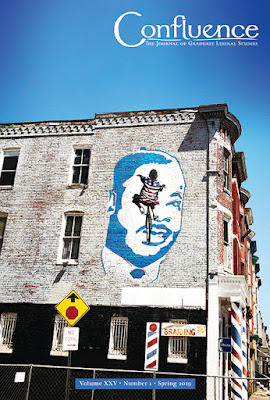
The Latest Issue of Confluence, Now Distributed Internationally by SDSU Press.


https://amzn.to/2LWYzCW
As part of a pilot program, SDSU Press is thrilled to announce an association with Confluence, a journal of the AGLSP, (Association of Graduate Liberal Studies Program)--AGLSP is the international mothership for MALAS-style Liberal Studies/Liberal Arts MA & PhD programs worldwide.

Check out their latest issue here in our SDSU Press/Amazon.com special order link.

What is Confluence? Glad you asked: "Confluence is a national, peer-reviewed, interdisciplinary journal published by the Association of Graduate Liberal Studies Programs (AGLSP) that reflects the best scholarly and creative work produced within and beyond AGLSP member institutions. Publishing scholarly essays and creative work such as short stories, poetry, creative nonfiction, and visual art, Confluence stands as a demonstration of and an inspiration to the kind of interdisciplinary engagement that is constitutive of a liberal education, while emphasizing the fundamental relations that transcend the boundaries of discipline and form that must be engaged and explored."

Thursday, July 18, 2019

Steven Bender's HOW THE WEST WAS JUAN--the perfect late fall 2019 syllabus addition for courses in political science, legal history, latin american studies and more...

Friday, May 31, 2019

The Day of the Lord Cometh: Nicholas Genovese's The Utopian Vision: Seven Essays on the Quincentennial of Sir Thomas More from San Diego State University Press

Rereading The Utopian Vision: Seven Essays on the Quincentennial of Sir Thomas More
Brian Frastaci, SDSU Press Editorial Assistant


Direct purchase from our SDSU Press Amz site.
Utopia has long had a bad rap. 

Members of nearly all political persuasions are frequently denounced as “utopian” in espousing an unrealistic and unattainable vision. Ideas are routinely held up “utopian” in the sense of “good in theory, untenable in practice.” If you believe in x, you’re a “utopian.” Might as well leave such things to the realm of fiction. Most espousing one ideology or another would avoid calling themselves “utopian” for these very reasons.
  
The very word utopia doesn’t help matters. Coined by Thomas More in his likewise-named work of 1516, utopia literally means “no place”—οὐτοπία, or outopia, for Greek-savvy readers. Obviously More wanted his readers to understand from the get-go that his was an impossible project. And unfortunately for ideologians of the modern day, this coinage stuck. 

But the idea of utopia hasn’t always been understood as an unattainable fantasy. From virtually the beginning of human civilization, people have traded ideas about the perfect society, and those perfect societies have always been understood as very real, whether an object of the past, present, or future. As SDSU’s own E.N. Genovese argues, two great traditions of utopia existed in antiquity. Those traditions may seem alien to us, but there are bound to be familiarities to the modern ear. What Genovese identifies as the “Indo-European” tradition is the idea that human civilization is cyclical, and that we of the modern day are (of course) in the worst possible existence, an “iron age” to be held in contempt to a past—and future—“golden age”, where justice reigns and humanity lives in an exalted state. The “Near Eastern” tradition, on the other hand, is the idea that a very real paradise currently does exist. This paradise usually takes the form of a garden, wherein there is no violence, no illness, and no suffering (paradise itself comes from a Persian word that means “a walled enclosure”). The Garden of Eden is the most obvious example of an ancient Near Eastern paradise, and as Genesis would have us believe, it does currently exist somewhere around Mesopotamia.  

As Genovese argues, the Indo-European and Near Eastern traditions survive and combine in the form of that great global religion, Christianity. It upholds the example of sinless man in a past paradise, in the Garden of Eden, and it believes in a presently existent paradise, the Kingdom of God in the heavens—both inheritances from Judaism, a Near Eastern religion. And as Jews came to believe before the time of Jesus, so did Christians: a future golden age is to come, the reign of God on earth. 

Two thousand years of interpretation have produced interesting takes on this utopian belief, and likewise lots of word soup. One mouthful possibly familiar to readers is Darbyite premillennialist dispensationalism, a modern interpretation of Jewish and Christian prophetic literature that features a “prophetic clock” operating throughout history. When God decides to start the now-frozen prophetic clock again, the earth will have seven years left before the return of Jesus with fire and brimstone. Fun events that will presage the end-times include a failed attack by Russia and Ethiopia on Israel and the installation of a single world government. Understandably, dispensationalists were excited when the modern nation-state of Israel and the United Nations were founded.


A dispensationalist timeline from 1919. Note the extraordinarily long toes of the Roman Catholic and Eastern Orthodox churches.

As the image shows, dispensationalism is quite complicated, but its appeal has not been dampened, particularly in the United States. Readers today can enjoy lots of dispensationalist literature, like the bestselling Left Behind series (all sixteen volumes of it) or even the widely panned Nicolas Cage movie of the same name (currently at a 1% "fresh" rating on Rotten Tomatoes).


The Left Behind movie (2014). If Genovese is correct, then this is a modern culmination of two venerably ancient traditions of utopia.
 
My point through all this is that a lot of toil has been spent on getting utopia right. And while I don’t espouse dispensationalism or many other utopian projects myself, I only want to suggest that we redefine the word utopia to mean something simpler: a better place. While many in the West don’t believe in a cyclical view of history anymore, many often uphold the glory of past societies as examples for our modern decrepit society to aspire to—see how often “the Founding Fathers”, the “good old days”, the 1950s, and so on, are looked upon with sometimes-religious fervor. And while many likewise don’t believe in a literal paradise existent somewhere else in the world, we often glorify other societies for their supposedly superior ways of life—Japan or Scandinavia, for instance—or maybe even ourselves—we in the United States are supposedly members of a “city on a hill,” as Ronald Reagan once dramatically put it. The idea of the “noble savage” also comes to mind, that colonized indigenous peoples enjoyed or enjoy a simplistic and morally upright idyllic existence in nature. 

In short, utopia is present nearly everywhere in modern discourse, but it doesn’t get recognized as such. Instead, it gets denigrated as a silly fantasy. To close, maybe we should understand utopia in an alternate reading: as eutopia, εὐτοπία—in other words, a good place, something we all hopefully aspire to.

(To read more on Genovese’s construction of ancient utopia, order SDSU Press’s very own The Utopian Vision: Seven Essays on the Quincentennial of Sir Thomas More, available on Amazon here. The book includes other essays on utopias throughout the centuries, such as utopias in Marxism, feminism, Russia, Comte, Vonnegut, and of course, More himself. It also contains the first-ever comprehensive annotated bibliography of utopia!)

 
(Learn more about utopia with SDSU Presss The Utopian Vision: 
Seven Essays on the Quincentennial of Sir Thomas More, available here at Amazon!)