
Wednesday, October 16, 2019
SDSU Press Co-sponsors CULTURE CLASH at San Diego State University, October 15, 2019


Tuesday, October 08, 2019
SDSU Press Proud to Support the Department of Chicana/o Studies 50th Anniversary Celebration With Culture Clash!
Or check out these posters below--click them to see them SUPERSIZE!


Wednesday, September 25, 2019
Carlos Gagini's REDEMPTIONS (A Translation of El Árbol Enfermo) Back in a new TRADE PAPERBACK Printing, perfect for the Latin American Studies/Literature Classroom!

A Latin American Literary classic back in print with an afterword by Costa Rican novelist Daniel Quiros! Carlos Gagini's REDEMPTIONS ... https://t.co/WgCjYmp6Rx pic.twitter.com/wkm2pdYTIt— San Diego State University Press (@SDSUPress) September 25, 2019


Tuesday, September 24, 2019
Newly Released Book! -- Tijuana: The History of a Mexican Metropolis -- From SDSU Press, San Diego State University
Tijuana: The History of a Mexican Metropolis

 |
| Third sanctuary of the First Baptist Church of Tijuana |
 David Ornelas is a graduate student in the Masters of Arts in Liberal Arts and Sciences cultural/interdisciplinary studies program at San Diego State University. His passion for reading books led to his work here with SDSU Press.
Sunday, September 22, 2019
Baja California Literature is an SDSU Press Specialty! ¡La literatura de Baja California es una especialidad de SDSU Press!
Tracking the Mexican literary diaspora one book at a time ... https://t.co/3wdXHsJJUx#baja #bajacalifornia #mexicanliterature #comparativeliterature #lafrontera #border #borders pic.twitter.com/cfCExoyUj5
— San Diego State University Press (@SDSUPress) September 22, 2019
Friday, September 20, 2019
Hot Off the Press: More Than Money: a Memoir by Claudia Dominguez from SDSU Press, San Diego State University
More Than Money: a Memoir , by Claudia Dominguez
 San Diego City Beat, the best of San Diego 2019, reviews graphic content from, More Than Money: a Memoir by Claudia Dominguez, “that gives readers an inside look at the corruption and lawlessness that plagues Mexico and addresses the stereotypes that often surround individuals that fall victim to organized crime organizations.”
Check it out here:

Interested? Check out the book in its entirety below!
https://www.amazon.com/More-Than-Money-Claudia-Dominguez/dp/1938537122/ref=sr_1_11?m=A119ICNS1106UD&qid=1568733795&s=merchant-items&sr=1-11
David Ornelas is a graduate student in the Masters of Arts in Liberal Arts and Sciences cultural/interdisciplinary studies program at San Diego State University. His passion for reading books led to his work here with SDSU Press.
Thursday, September 12, 2019
Our Bestseller: Trilingual Education: Sign Language, Spanish, English by Professors Ben and Kathie Christensen from SDSU Press, San Diego State University
 Trilingual Education: Sign Language, Spanish, English by Professors Ben and Kathie Christensen, is a unique manual developed to facilitate the communication of clear concepts between Spanish-speaking parents and their deaf children. Using a series of clear exercises and diagrams, it provides a basic tool for interchange among users of three different languages: spoken English, spoken Spanish, and American Sign Language.
Most sign language books normally just have English content. Trilingual English has more than just English content (Spanish and Sign Language). It allows students who sign in Spanish to learn new words or phrases that they may haven't been taught before.
Now on sale direct from SDSU Press here:
David Ornelas is a graduate student in the Masters of Arts in Liberal Arts and Sciences cultural/interdisciplinary studies program at San Diego State University. His passion for reading books led to his work here with SDSU Press.
Monday, September 09, 2019
The Literature of the Kumeyaay -- From SDSU Press, the University Press of San Diego State University
Check out our latest bestseller! https://t.co/yy0FBmU9fv#nativeamerican #kumeyaay #comparativeliterature #literatureoftheamericas #americanindianstudies pic.twitter.com/Exc2etxY0Q
— San Diego State University Press (@SDSUPress) September 9, 2019
Thursday, August 01, 2019
The Latest Issue of Confluence, Now Distributed Internationally by SDSU Press.

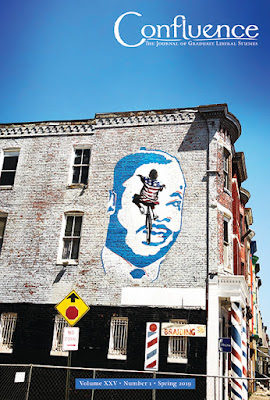
Check out their latest issue here in our SDSU Press/Amazon.com special order link.
What is Confluence? Glad you asked: "Confluence is a national, peer-reviewed, interdisciplinary journal published by the Association of Graduate Liberal Studies Programs (AGLSP) that reflects the best scholarly and creative work produced within and beyond AGLSP member institutions. Publishing scholarly essays and creative work such as short stories, poetry, creative nonfiction, and visual art, Confluence stands as a demonstration of and an inspiration to the kind of interdisciplinary engagement that is constitutive of a liberal education, while emphasizing the fundamental relations that transcend the boundaries of discipline and form that must be engaged and explored."
Saturday, July 20, 2019
In Honor of Comic-Con 2019, Amatl Comix has Supercharged its World Wide Web Headquarters!
Our new comics imprint, #amatlcomix #amatlcomics https://t.co/F2bvqZ47NW, is evolving!
— San Diego State University Press (@SDSUPress) July 20, 2019
Check it out here and welcome aboard, officially to the Amatl editorial board, @ProfessorLatinx, Dr. Frederick Aldama, and Sam Cannon! pic.twitter.com/wBxJ52sN8f
Thursday, July 18, 2019
Steven Bender's HOW THE WEST WAS JUAN--the perfect late fall 2019 syllabus addition for courses in political science, legal history, latin american studies and more...
Just a reminder about another of our more recent border/frontera-laced publications--a meditation, by noted legal scholar Steven Bender, HOW THE WEST WAS JUAN. The direct SDSUPress/Amazon purchase link is here https://t.co/aZa36lcfs2 #border #theborder #usmexico #lafrontera pic.twitter.com/i7rBqjrTSw
— San Diego State University Press (@SDSUPress) July 18, 2019
Friday, July 05, 2019

Friday, May 31, 2019
The Day of the Lord Cometh: Nicholas Genovese's The Utopian Vision: Seven Essays on the Quincentennial of Sir Thomas More from San Diego State University Press
Brian Frastaci, SDSU Press Editorial Assistant
 |
| Direct purchase from our SDSU Press Amz site. |
Members of nearly all political persuasions are frequently denounced as “utopian” in espousing an unrealistic and unattainable vision. Ideas are routinely held up “utopian” in the sense of “good in theory, untenable in practice.” If you believe in x, you’re a “utopian.” Might as well leave such things to the realm of fiction. Most espousing one ideology or another would avoid calling themselves “utopian” for these very reasons.
The very word utopia doesn’t help matters. Coined by Thomas More in his likewise-named work of 1516, utopia literally means “no place”—οὐτοπία, or outopia, for Greek-savvy readers. Obviously More wanted his readers to understand from the get-go that his was an impossible project. And unfortunately for ideologians of the modern day, this coinage stuck.
But the idea of utopia hasn’t always been understood as an unattainable fantasy. From virtually the beginning of human civilization, people have traded ideas about the perfect society, and those perfect societies have always been understood as very real, whether an object of the past, present, or future. As SDSU’s own E.N. Genovese argues, two great traditions of utopia existed in antiquity. Those traditions may seem alien to us, but there are bound to be familiarities to the modern ear. What Genovese identifies as the “Indo-European” tradition is the idea that human civilization is cyclical, and that we of the modern day are (of course) in the worst possible existence, an “iron age” to be held in contempt to a past—and future—“golden age”, where justice reigns and humanity lives in an exalted state. The “Near Eastern” tradition, on the other hand, is the idea that a very real paradise currently does exist. This paradise usually takes the form of a garden, wherein there is no violence, no illness, and no suffering (paradise itself comes from a Persian word that means “a walled enclosure”). The Garden of Eden is the most obvious example of an ancient Near Eastern paradise, and as Genesis would have us believe, it does currently exist somewhere around Mesopotamia.
As Genovese argues, the Indo-European and Near Eastern traditions survive and combine in the form of that great global religion, Christianity. It upholds the example of sinless man in a past paradise, in the Garden of Eden, and it believes in a presently existent paradise, the Kingdom of God in the heavens—both inheritances from Judaism, a Near Eastern religion. And as Jews came to believe before the time of Jesus, so did Christians: a future golden age is to come, the reign of God on earth.
Two thousand years of interpretation have produced interesting takes on this utopian belief, and likewise lots of word soup. One mouthful possibly familiar to readers is Darbyite premillennialist dispensationalism, a modern interpretation of Jewish and Christian prophetic literature that features a “prophetic clock” operating throughout history. When God decides to start the now-frozen prophetic clock again, the earth will have seven years left before the return of Jesus with fire and brimstone. Fun events that will presage the end-times include a failed attack by Russia and Ethiopia on Israel and the installation of a single world government. Understandably, dispensationalists were excited when the modern nation-state of Israel and the United Nations were founded.
 |
| A dispensationalist timeline from 1919. Note the extraordinarily long toes of the Roman Catholic and Eastern Orthodox churches. |
As the image shows, dispensationalism is quite complicated, but its appeal has not been dampened, particularly in the United States. Readers today can enjoy lots of dispensationalist literature, like the bestselling Left Behind series (all sixteen volumes of it) or even the widely panned Nicolas Cage movie of the same name (currently at a 1% "fresh" rating on Rotten Tomatoes).
 |
| The Left Behind movie (2014). If Genovese is correct, then this is a modern culmination of two venerably ancient traditions of utopia. |
My point through all this is that a lot of toil has been spent on getting utopia right. And while I don’t espouse dispensationalism or many other utopian projects myself, I only want to suggest that we redefine the word utopia to mean something simpler: a better place. While many in the West don’t believe in a cyclical view of history anymore, many often uphold the glory of past societies as examples for our modern decrepit society to aspire to—see how often “the Founding Fathers”, the “good old days”, the 1950s, and so on, are looked upon with sometimes-religious fervor. And while many likewise don’t believe in a literal paradise existent somewhere else in the world, we often glorify other societies for their supposedly superior ways of life—Japan or Scandinavia, for instance—or maybe even ourselves—we in the United States are supposedly members of a “city on a hill,” as Ronald Reagan once dramatically put it. The idea of the “noble savage” also comes to mind, that colonized indigenous peoples enjoyed or enjoy a simplistic and morally upright idyllic existence in nature.
In short, utopia is present nearly everywhere in modern discourse, but it doesn’t get recognized as such. Instead, it gets denigrated as a silly fantasy. To close, maybe we should understand utopia in an alternate reading: as eutopia, εὐτοπία—in other words, a good place, something we all hopefully aspire to.

Thursday, May 16, 2019
San Diego's Sestercentennial Got You Feeling Reminiscent? We've Got the Cure: Mourning Dove's Stories - An Authentic Compilation of Native Tales
 |
| Mourning Dove lived 1884-1936 in the native borderlands between Washington and Canada. |
Published in American Indian Studies at San Diego State University, comes Mourning Dove’s Stories, a rare unaltered collection of Mourning Dove’s original works.
